_edited.jpg)
TM

Fireflies of Pennsylvania

This page is dedicated to answering some basic questions that are frequently asked about our State Insect, the Firefly! We have over 30 species of fireflies in Pennsylvania that are each fascinating in their own right and worthy of our attention and protection. Pennsylvania's State Insect, the "Dot-Dash" firefly or Photuris pensylvanica was officially adopted in 1974 by Pennsylvania's General Assembly. It is identified by a dot-dash flash pattern, and most often occurs in the Southeastern areas of the Commonwealth. The International Union for the Conservation of Nature (IUCN) lists P. pensylvanica as a "Vulnerable" species (one step away from Endangered) on the IUCN Red List. Therefore, we hope citizens of Pennsylvania will learn more and take steps to protect ALL of our fireflies for our future generations.
FAQ's
The following are answers to some commonly asked questions at our festival and events. Our mission is to educate and raise awareness about the fireflies in our Commonwealth. We have been learning as much as we can about fireflies from our International Firefly Network friends and advisory board for the last 15 years.

Are they lightning bugs or fireflies?
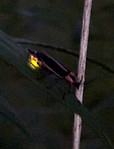
Fireflies vs. lightning bugs. Either term is fine. They are actually beetles. They have a pair of black leathery protective of wings covering the real wings with which they fly. They have 6 legs. They undergo a series of stages as they grow called metamorphosis.
Where do fireflies come from?
Fireflies do not migrate. Unless conditions become unfavorable, fireflies develop and remain in the habitats throughout their life cycle.
Do all fireflies glow?
We know the nocturnal glowing lightning bug species best, but there are several firefly species that are active during the day (diurnal) and don’t light up.
Why do fireflies have different flash patterns?
There are often multiple species of fireflies in a habitat, and each have a distinct flash pattern in order to distinguish themselves from their cousins. The males are the fireflies we see flying around and the females are usually waiting in the grass or on a leaf. When she sees the flash pattern of a male of her species, she will signal to him and he will fly down to mate.
What is the lifecycle of a firefly?
After adult fireflies mate, the females lay eggs on the ground or just below the surface of the soil. They prefer moist areas with leaf litter and undisturbed soils. The eggs hatch within the month, and stay in larval form (sometimes called glow-worms) for 1 to 2 years. They "hibernate" in the ground or under tree bark in the winter. The larvae emerge in spring and feed heavily until they pupate. A pupa is a firefly stage just before adulthood, lasting only about two weeks when they transform and emerge as an adult insect (imago). Then the cycle begins again.
How long do fireflies live?
Adult fireflies only live for a few days to a couple of weeks – some species live longer than others, and weather conditions can impact the life span. They do not migrate. They reproduce and die. They live out their entire life cycle within the general geographic area where they hatched as larvae. The larvae can live for up to two years in the soil.
Do they bite? Are they poisonous?
Adult fireflies don’t bite or sting! However, most fireflies are toxic to vertebrates like birds, amphibians, or mammals. All firefly larvae and pupae glow, which may be a warning sign – “Don’t eat me!”
What do fireflies eat?
Most firefly species eat little or nothing at all, but some may feed on nectar or pollen. However, some adult female fireflies are predatory, feeding on other firefly species whom they attract by imitating their prey’s flash patterns often called the “Femme Fatale”. Firefly larvae, on the other hand, are voracious carnivores and prey on soft-bodied creatures like slugs, snails and worms.
What makes fireflies light up?
In short, there is a biochemical reaction that takes place in their body that makes them glow. The light that fireflies produce is called a “cold light” because it doesn’t give off heat the way most energy-consuming sources do (like fire, the sun, light bulbs, etc.). They are not radioactive. Longer answer: Fireflies have a protein (luciferin) in their bodies that combines with a catalyst (luciferase), creating a glowing molecule that can be triggered by introducing Adenosine Triphosphate, ATP.
Are fireflies endangered?
Some species have declined significantly. It is estimated 14% of fireflies are threatened in the U.S. Another 53% of identified firefly species in the U.S. have, however, insufficient data to make a determination of threat. Currently, Synchronous fireflies are not on the threatened list.
Probably the greatest effect on firefly populations in the U.S. is the destruction of their habitat. Environmental changes with negative impact such as pesticide use, light pollution and loss of habitat due to development are also believed to be causing significant decline in fireflies as well as other insects.
Why is this region so important to fireflies?
Forest County is a prime location for fireflies because of its large undeveloped tracts such as the Allegheny National Forest, Cook Forest and numerous State Forests and Parks and many public game lands in the region. Large forested areas mean less disruption of habitat, and sparse human population means less light pollution. The relatively smaller number of farms means less pesticide use.
Fireflies do best where there is abundant darkness, leaf litter, moisture and undisturbed soil.
Why are fireflies important?
Fireflies are known as a bioindicator to researchers, biologists and conservationists. The presence of fireflies tells us that the environment is healthy and well balanced. Firefly larvae also help by keeping the other populations of invertebrates in check by eating snails, slugs, etc. If you don’t see fireflies in an area that typically should or did have them, there is a reason and you should be concerned.
Can I look for fireflies on my own; if so why do I need a guide?
The simple answer is YES, and many species are easily found in abundance throughout Pennsylvania and in Forest county. The hard part is knowing where and when to find them. It is also essential to follow rules of engagement for "hunting" fireflies safely and responsibly.
It gets more complicated if you're looking for a specific species like Synchronous fireflies, Phontinus carolinus. Synchronous fireflies are most active during the weeks around the Summer Solstice in late June and early July in the Allegheny National Forest area. Synchronous fireflies do not wake up and start flashing until 1 hour after sundown (which 10-10:30 pm in June). They often don't synchronize until after 11 pm. Their preferred habitats are dark, old growth forest areas, near creeks. These areas are highly sensitive habitats, and require extra caution and care especially at night. Check our Leave No Trace page for tips on conducting a safe and sustainable "firefly hunt".
If we don't protect the habitats and the fireflies from human impacts, we take a chance on losing them. Also note that the forest is wild, and if you aren't prepared and knowledgable, you can find yourself in a dangerous situation. We strongly encourage the public to seek a professionally guided program or tour for the sake of the fireflies and your protection as well. It may require that you enter a lottery or pay a fee, but you will be protecting nature for the future generations.
Where can I go to see fireflies on my own?
There are public areas located throughout Forest County including the US Army Corps of Engineers managed Tionesta Creek and Lake campgrounds and the Allegheny National Forest Recreation Areas and campgrounds. Just be sure to go early before dark, stay on the durable surfaces; park in designated parking lots and stay on the trails. Please refer to our Leave No Trace recommendations when going to these sites for firefly viewing.
Remember, some of the best viewing sites don't require a long trip. Sometimes the best show is in your own backyard, on your cabin porch or around your campsite. Just turn off lights, let your campfire die down. Relax, sit and watch as the darkness reveals the tiny peaceful signals of love... "Nature's Fireworks!"